Skip to content


If you drive in Little Rock, some intersections probably make you grip the steering wheel a little tighter. That instinct is backed by data. The dangerous intersections in Little Rock aren’t just anecdotally bad — they’re consistently flagged by crash reports, insurance data, and state safety analyses as some of the most hazardous in Arkansas.
The numbers paint a sobering picture of traffic safety in our state and our city:
- Arkansas has the nation’s 4th-highest roadway fatality rate — 21.1 deaths per 100,000 people in 2022 (ACHI)
- 4,089 roadway fatalities statewide between 2016 and 2022
- 641 Arkansans died on the road in 2022 alone
- Pulaski County has the highest number of fatal highway crashes per year in Arkansas
- Little Rock metro ranked 10th deadliest in the country for pedestrians
This guide breaks down the five most dangerous intersections in Little Rock, what makes them hazardous, and what to do if you’re involved in a crash. NST Law has two offices in Little Rock — West Little Rock and Downtown — and our Little Rock personal injury lawyers have been helping injured drivers across central Arkansas for over 35 years.
Table Of Contents
- The 5 Most Dangerous Intersections in Little Rock
- Other Dangerous Roads and Corridors in Little Rock
- Why Little Rock Intersections Are So Dangerous
- What to Do After a Car Accident at a Little Rock Intersection
- Arkansas Laws That Affect Your Intersection Accident Case
- What Little Rock Is Doing to Improve Intersection Safety
- Contact NST Law’s Little Rock Car Accident Lawyers
- Frequently Asked Questions About Dangerous Little Rock Intersections
The 5 Most Dangerous Intersections in Little Rock
Multiple data sources — including the State Farm Danger Index, ARDOT crash data, and Little Rock Police Department records — consistently flag the same intersections. Here are the top five.
1. Asher Avenue & South University Avenue
- State Farm Danger Index score: 932 — ranked the most dangerous intersection in all of Arkansas
- Heavy vehicle and foot traffic due to proximity to the University of Arkansas at Little Rock campus
- Particularly dangerous on game days and during campus events, when frustrated drivers make poor decisions in heavy congestion
- High number of lanes creates confusion for unfamiliar drivers
2. Bowman Road & Chenal Parkway
- State Farm Danger Index score: 780
- Located in West Little Rock — heavy traffic from shopping centers, restaurants, and nearby Baptist Health Medical Center
- Blind spots caused by tree lines and ignored speed limits along Chenal Parkway have drawn repeated resident complaints
- Abundance of traffic lights and shopping center entrances create constant conflict points
3. Baseline Road & Chicot Road
- State Farm Danger Index score: 756
- High-traffic commercial corridor in Southwest Little Rock
- Frequent left-turn conflicts and red-light running
4. Bowman Road & West Markham Street
- State Farm Danger Index score: 732
- Congested commercial corridor with heavy rush hour traffic
- Speeding is a common factor in crashes here
5. Shackleford Road & West Markham Street
- State Farm Danger Index score: 600
- Dangerous due to traffic from Baptist Health, businesses, restaurants, and taverns on Shackleford
- Proximity to the I-430/I-630 interchange compounds congestion and creates aggressive merging
Other Dangerous Roads and Corridors in Little Rock
Beyond the top five intersections, several roads and corridors in Little Rock consistently see high crash volumes:
- I-430 & I-630 interchange — Massive junction where two interstates converge; high volume of merging, exiting, and lane changes
- I-30 Arkansas River Bridge — Key entry to downtown; common spot for rear-end and sideswipe collisions
- Cantrell Road (Highway 10) — Major route through the city with a mix of commercial and residential traffic, twists, and turns
- Rodney Parham Road — Frequent intersections create many rear-end and side-impact collisions
- University Avenue — High density of businesses and pedestrian traffic; frequent crashes at intersections and crosswalks
- I-630 — Processes approximately 112,000 vehicles daily; heavy commuter corridor
- I-30 construction (Connecting Arkansas Program) — Active construction zones with lane closures and shifting traffic patterns create additional hazards
Why Little Rock Intersections Are So Dangerous
Several factors combine to make Little Rock one of the more dangerous cities to drive in. Many of these are common causes of car accidents that are amplified by local conditions:
- Distracted driving — Cell phone use, GPS, and texting remain leading causes of intersection crashes
- Speeding and red-light running — Especially at wide, multi-lane intersections where drivers try to beat yellow lights
- Impaired driving — Alcohol impairment accounted for 24% of Arkansas traffic fatalities; Pulaski County saw 1,731 alcohol-related crashes between 2015–2019. If you’ve been hit by a drunk driver, you have legal options.
- Complex road design — Confusing lane configurations, short turn arrows, and poor signal timing
- Inadequate lighting and signage — Particularly dangerous at night on corridors like Cantrell Road and University Avenue
- High traffic volume — Little Rock sits at the convergence of I-30 and I-40, making it a major transportation hub with heavy truck traffic mixing with commuters
- Weather — Arkansas averages 50.6 inches of annual rainfall and was ranked the #1 most dangerous state for driving in rain (Safewise)
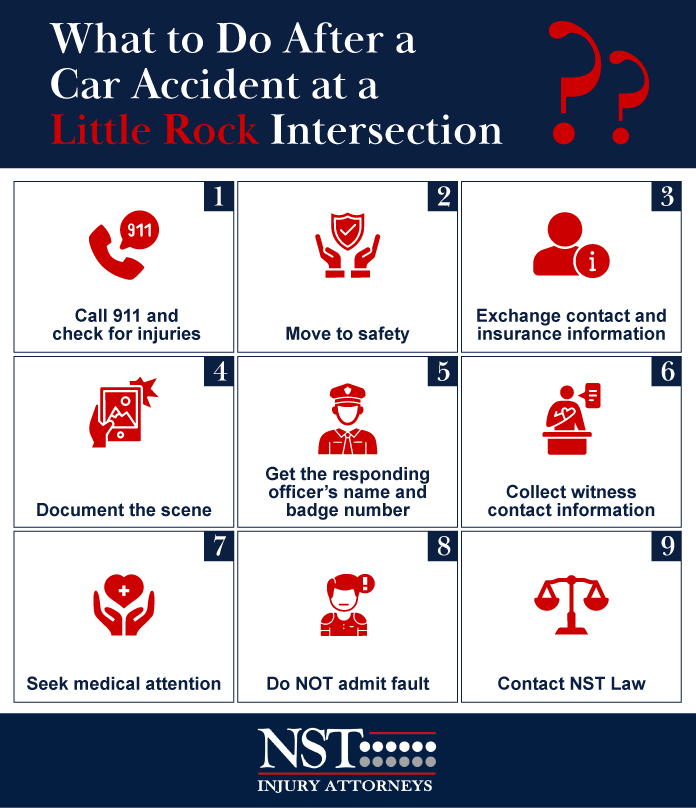
What to Do After a Car Accident at a Little Rock Intersection
The steps you take after an intersection accident matter. Here’s what to do after being involved in a car accident:
- Call 911 and check for injuries
- Move to safety if possible
- Exchange contact and insurance information with all parties
- Document the scene — Photos/videos of damage, the intersection, signals, road conditions, and weather
- Get the responding officer’s name and badge number; request a copy of the police report
- Collect witness contact information
- Seek medical attention — Even if injuries seem minor. Some injuries don’t show symptoms right away.
- Do NOT admit fault or give recorded statements to insurance adjusters
- Contact NST Law for a free consultation — we can help protect your rights from day one
Arkansas Laws That Affect Your Intersection Accident Case
Statute of Limitations
Arkansas gives you three years from the date of your accident to file a personal injury lawsuit (Ark. Code Ann. § 16-56-105). That may sound like plenty of time, but evidence fades, witnesses become harder to locate, and insurance companies use delay tactics. Don’t wait.
Comparative Fault
Arkansas follows a modified comparative fault system (Ark. Code Ann. § 16-64-122):
- You can recover if your share of fault is less than 50%
- Your damages are reduced by your percentage of fault
- If you’re 50% or more at fault, you recover nothing
Insurance adjusters will try to shift blame onto you. An experienced attorney helps ensure fault is assigned fairly.
Reporting Requirements
Arkansas law requires reporting any accident involving injuries or significant vehicle damage to police. The police report is a key piece of evidence for establishing fault.
What Little Rock Is Doing to Improve Intersection Safety
Little Rock is taking steps to address its dangerous roadways:
- $25 million federal SS4A grant awarded in 2024 to make improvements to five major corridors along the city’s high-injury network
- Planned improvements include medians, dedicated turn lanes, pedestrian refuge islands, roundabouts, and lighting enhancements
- Central Arkansas Safety Action Plan approved by the Little Rock City Board in 2024 — goal of a 40% reduction in fatal and serious injuries by 2040
- Recent upgrades to University Avenue including improved visibility, updated signals, and widened lanes
- I-30/I-40 interchange improvements planned as part of ongoing infrastructure investment
These are positive steps, but they take time. In the meantime, Little Rock drivers need to stay alert — especially at the intersections listed above.
Contact NST Law’s Little Rock Car Accident Lawyers
NST Law has two offices in Little Rock to serve you — West Little Rock (4 Shackleford Plaza) and Downtown (425 W Capitol Ave). Our team has been fighting for injured Arkansans for over 35 years.
Why Little Rock drivers trust NST Law:
- Billions won for injured clients
- 175 lawyers and staff with the resources to take on tough cases
- Every case prepared for trial — because that’s what gets results
- Free consultation, no fee unless we win
- Available 24/7 — we’ll travel to meet you wherever you are
If a loved one was killed in an intersection accident, our wrongful death lawyers can help your family pursue justice. You can also view our results and read what our past clients say about working with us.
Call NST Law today at 501-435-0000 or fill out our online contact form to get started.
Frequently Asked Questions About Dangerous Little Rock Intersections
What is the most dangerous intersection in Little Rock?
Asher Avenue and South University Avenue — ranked #1 in all of Arkansas by the State Farm Danger Index with a score of 932. Heavy traffic from the University of Arkansas at Little Rock campus, a confusing lane layout, and high volumes of both vehicles and pedestrians make this intersection consistently hazardous.
What should I do after a car accident at a Little Rock intersection?
Call 911, check for injuries, move to safety, document the scene, exchange information with all parties, collect witness contacts, get the police report, seek medical attention, and contact an attorney before giving any recorded statements to insurance companies.
How long do I have to file an injury claim after a Little Rock car accident?
Three years from the date of the accident under Ark. Code Ann. § 16-56-105. While this is more time than some states allow, don’t wait — evidence deteriorates and witnesses become harder to find.
Can I still recover compensation if I was partially at fault?
Yes. Arkansas’s modified comparative fault system allows you to recover damages as long as your share of fault is less than 50%. Your compensation is reduced by your percentage of fault. Learn more about what your case may be worth.
Why are Little Rock intersections so dangerous?
Heavy traffic at the convergence of I-30 and I-40, complex road designs with confusing lane configurations, distracted and impaired driving, weather (Arkansas is ranked #1 for dangerous rain driving), and inadequate lighting and signage all contribute.
Is the city doing anything to make intersections safer?
Yes. Little Rock received a $25 million federal SS4A grant in 2024 to improve five high-injury corridors. The Central Arkansas Safety Action Plan targets a 40% reduction in fatal and serious injuries by 2040. Upgrades to University Avenue and the I-30/I-40 interchange are also planned or underway.