
 Skip to content
Jackson, MS is a city defined by its history, but for many local drivers, it is also defined by its traffic. Between the daily congestion on Lakeland Drive and the high-speed merges of I-55, navigating the “City with Soul” requires constant vigilance. Unfortunately, even the most careful drivers can find themselves involved in a collision at one of Jackson’s high-risk crossings. Our Jackson MS car accident lawyers are ready to support you.
The statistics for Mississippi road safety are a call to action:
This guide identifies the five most dangerous intersections in Jackson based on historical crash frequency and local traffic patterns. If you’ve been injured in an accident, NST Law’s Jackson office is located at 125 South Congress Street.
While road improvements are ongoing, several intersections in Jackson consistently see high volumes of rear-end and side-impact (T-bone) collisions.
Arguably the busiest intersection in the state, this area serves as a major gateway for commuters and those visiting St. Dominic Hospital. The complex merge patterns and heavy volume during rush hour create frequent conflict points.
Located in a high-stress medical corridor near UMMC, this intersection sees frequent side-impact crashes. Drivers often attempt to beat changing lights, leading to high-speed collisions in a zone with heavy pedestrian activity.
This retail hub is a “perfect storm” for accidents. Between shoppers entering the various plazas and commuters merging onto I-55, distracted driving and failure-to-yield accidents are exceptionally common here.
With a mix of heavy commercial trucks and local commuter traffic, this intersection is notorious for high-impact crashes. US-80’s higher speed limits mean that accidents here often result in more severe injuries.
The transition from highway speeds to local stops at Hanging Moss Road is a frequent site for rear-end collisions. Poor visibility during inclement weather and road curvature compound the danger for Jackson motorists.
Beyond individual intersections, certain stretches of road in the Jackson Metro area are consistently identified as hazardous:
Several factors contribute to the high crash rates at our city’s crossroads:
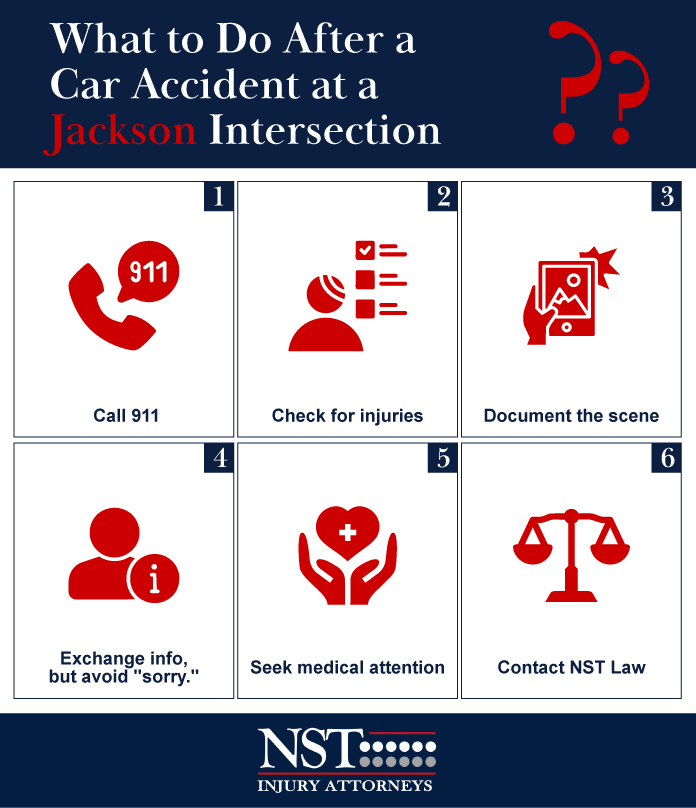
If you are involved in a collision, the steps you take in the first 30 minutes are critical for your health and your legal claim:
In Mississippi, you generally have three years from the date of the accident to file a personal injury lawsuit (Miss. Code § 15-1-49). While this is longer than in some neighboring states, evidence like traffic camera footage can disappear quickly. It is best to act as soon as possible.
Mississippi follows a “Pure Comparative Negligence” system. This means you can still recover compensation even if you were 99% at fault—however, your recovery will be reduced by your percentage of blame. If you are awarded $100,000 but found 20% at fault for speeding, you would receive $80,000.
Mississippi is an at-fault state. The driver responsible for the accident (and their insurance company) is responsible for the damages. Our team helps prove liability to ensure you aren’t left paying for someone else’s mistake.
NST Law has been serving the Mid-South for over 30 years. Our Jackson office is located at 125 S Congress St, Suite 1300, and we are ready to serve as your Champions for the Injured.
Call NST Law today at 601-488-3483 or fill out our online contact form to get started.
Based on traffic volume and historical crash data, Lakeland Drive & the I-55 Frontage Road is consistently ranked as one of the most hazardous intersections due to its high congestion and complex merging patterns.
The statute of limitations for most car accidents in Mississippi is three years. However, claims against government entities (like a city-owned vehicle) have a much shorter one-year deadline under the Mississippi Tort Claims Act.
Yes. Under Mississippi’s pure comparative negligence law, you can still recover compensation, though your total award will be reduced by your percentage of fault.
No. You should speak with a lawyer before providing any statements. Insurance adjusters often use these recordings to find ways to reduce or deny your claim.